Start with the meter: a ten-minute test
Shut off every fixture and appliance that uses water, including the ice maker and any irrigation timer. Find your water meter, usually in a ground-level box near the street, and look at the low-flow indicator, often a small triangle or dial. If it moves with everything off, water is leaving the system somewhere.
Next, close the main shutoff at the house and look again. If the meter stops, the leak is inside the house. If it keeps running, the leak is in the line between the meter and the house. Tell us what you saw when you call and we bring the right equipment.
When a leak is an emergency, and when it can wait
Most leaks show up through a symptom, not a puddle.
- A water bill that jumped without a change in habits.
- A meter that moves with all fixtures off.
- A warm spot on a slab floor, or the sound of running water in a quiet house.
- A stain, bubble, or soft spot in drywall or ceiling.
- Low pressure that appeared suddenly, or a wet area in the yard between meter and house.
How we find the leak without opening everything
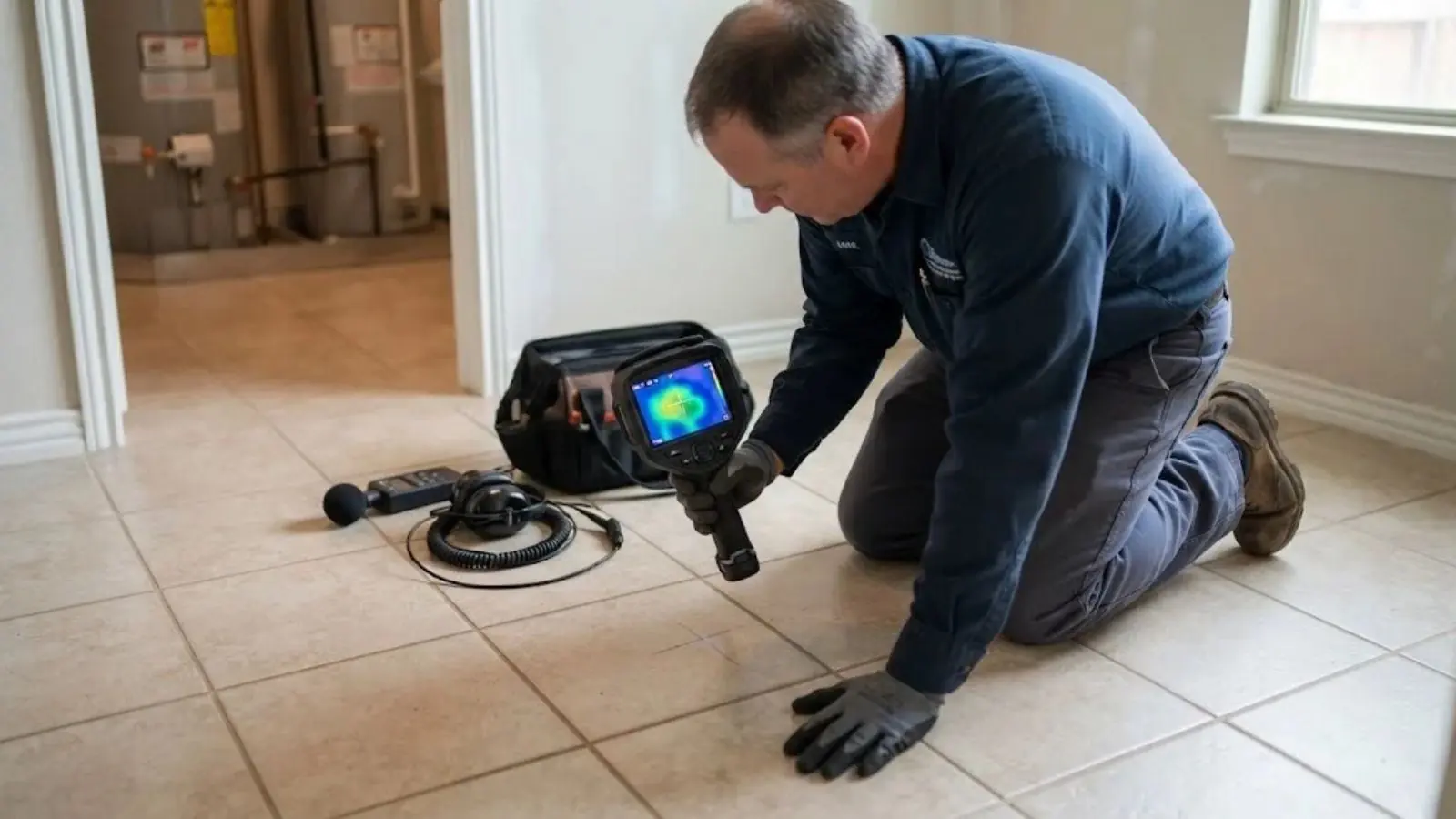
We use acoustic listening equipment, which picks up the sound of escaping water in pipes, and thermal imaging, which shows the temperature difference where hot water leaks into a wall or slab. For pressure-fed lines, we isolate sections and test, narrowing the leak to a short stretch.
The aim is to mark a spot on the surface and open only that spot. Where a leak is on the hot side under a slab, our slab leak repair page explains the repair paths.
The leak between the meter and the house
The water service line is the pipe that runs from the meter to the house. It is buried, you cannot see it, and when it leaks the first clue is often the bill, a soft patch in the yard, or low pressure. We trace the line, pressure test it, and listen along its length to find the break.
Repair options are a spot dig for a short failure or a new service line when the pipe is old or repeated breaks are likely. We call Arizona 811 before any dig so utilities can mark lines. Homeowners should do the same, since the service is free.
Where the leak is and what it usually takes
A quick map of leak locations and the usual fix.
| Location | How it shows up | Usual repair path |
|---|---|---|
| Inside a wall or ceiling | Stain, bubble, or musty smell | Open a small access, repair or replace the section |
| Under the slab | Warm floor, meter running, wet carpet | Spot break, reroute, or repipe |
| Service line to the house | Meter running, soft yard | Spot dig or new line |
| Irrigation line or valve | Wet lawn, high bill in dry weather | Isolate and repair the zone |
| Pool or spa plumbing | Level drops more than evaporation | Pressure test the lines |
Irrigation, pools, and the desert evaporation problem
Drip lines, sprinkler valves, and backflow assemblies leak quietly, and a high summer bill is often blamed on watering when part of it is a broken line. We test irrigation zones to separate a leak from normal use.
Pools and fountains lose water to evaporation in desert heat even when nothing leaks. A bucket test, where you compare the pool's drop with a bucket of water set on a step, helps tell evaporation from a leak. If the pool loses more than the bucket, call us and we pressure test the lines.
What affects the price of leak detection
You get a clear price before work starts.
- ScopeA single suspected leak costs less to trace than a whole-house survey.
- LocationSlab, wall, and buried service lines need different gear.
- AccessFinished floors and tight crawl spaces take longer.
- RepairFinding the leak and fixing it are priced separately, and you decide after the finding.
- Time of callAfter-hours dispatch may differ from a daytime visit.
Many policies cover sudden water damage but not the pipe, and some cover the cost of tearing out to reach a leak. Ask your insurer. Call (855) 575-2890 for your real number.
Sahuarita homes and where leaks hide
Nearly all Sahuarita homes are built on a slab, so most hidden supply lines run in the attic, in walls, or under the concrete. That makes thermal and acoustic detection especially useful, since there is no basement or crawlspace to walk through. Pipe material depends on the builder and the year, so ask for your home records or have the lines checked. Owners in the Quail Creek community can read our Quail Creek page for tips on leaving a home empty for weeks.
Green Valley homes built from the 1980s onward may have older copper that can develop pinholes. If your home is older and the bill has crept up, ask us whether a whole-house pressure test is worth doing.
What the EPA says about household leaks
According to the EPA's WaterSense program, the average household's leaks can account for more than 9,300 gallons of water wasted every year. Common sources are worn toilet flappers, dripping faucets, and leaking valves.
Fixing them is among the least expensive ways to cut a water bill.
Safe steps before we arrive
These steps protect you and speed up the visit.
- Shut the main valve if water is flowing, and note the meter reading first.
- Switch off power to wet areas only if you can reach the breaker without standing in water.
- Move rugs and valuables away from wet floors.
- Photograph stains, the meter, and any damage for your insurer.
- Keep children and pets out of the wet area.
Leak detection questions from Sahuarita homeowners
Do you handle leak emergencies at night or on weekends in Sahuarita?
Yes. Dispatch is 24/7. Shut the main valve to stop the water, then call and we send a plumber the same day when the schedule allows.
My water bill doubled. How do I know if I have a leak?
Run the meter test in the first section. If the meter moves with everything off, you have a leak. If not, the cause may be use or irrigation.
Can you find a leak without breaking the wall or floor?
Often yes. Listening gear and thermal imaging narrow the location so we open only a small area.
Is a slab leak an emergency?
It can be if water reaches the floor or the meter runs fast. See our slab leak repair page.
Do you find leaks in pools or irrigation?
Yes, using pressure tests and zone checks. We tell you whether the loss is a leak or normal evaporation.
Do you serve Green Valley?
Yes. See the Green Valley page.